
Top-Rated Garage Door Repair in Kaufman, TX
If your Kaufman door seals in March and shows daylight in September, the door is not the problem. Lubbock TX Handyman checks the opening for square before selling you a single part.
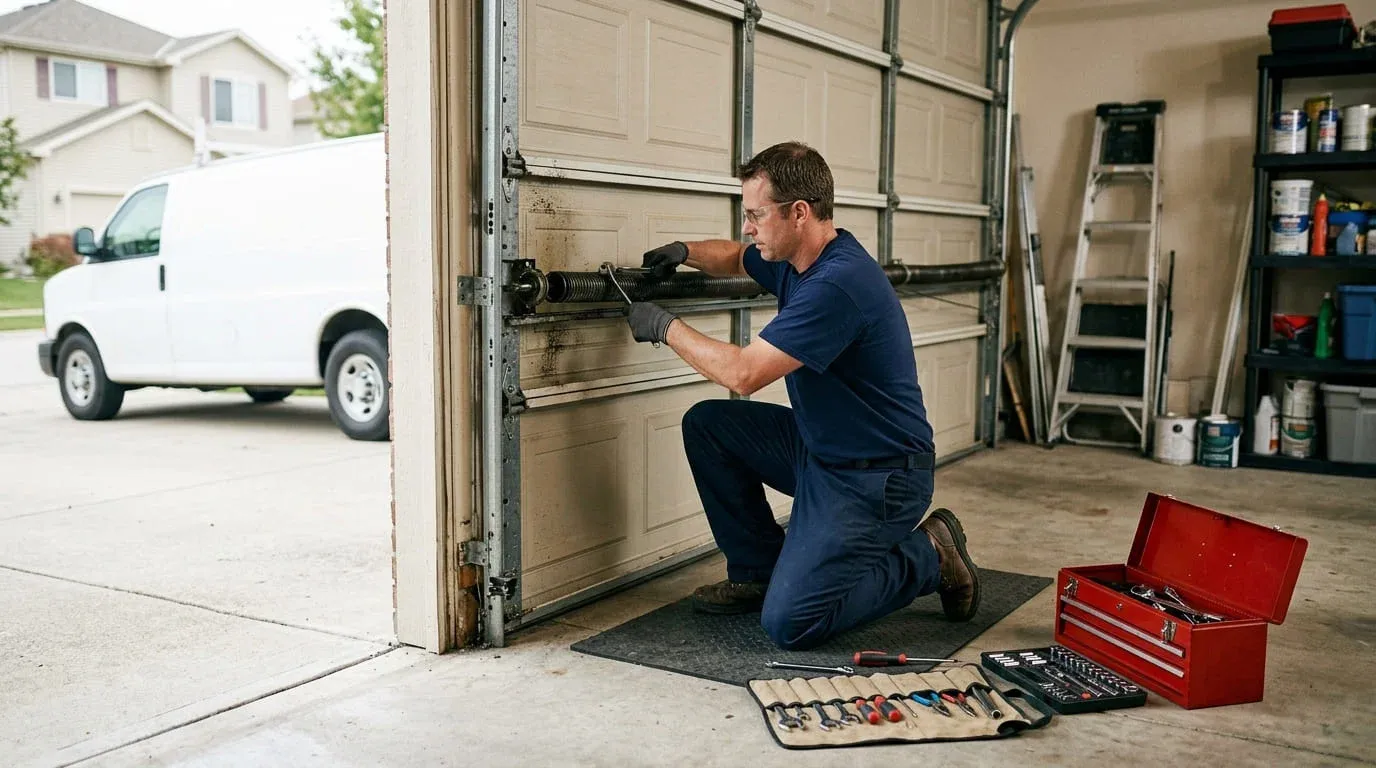
In Kaufman the door is straight. The opening moves with the seasons.
Garage door repair in Kaufman is soil work disguised as door work about
half the time. Kaufman is the county seat, a city of roughly 8,500
people sitting squarely in the Blackland Prairie, and the clay under
this town has some of the highest shrink-swell potential of any soil in
Texas. It takes on water through a wet spring and expands, then dries
and contracts hard through an August drought, and everything built on
it moves with it.
The garage opening feels that movement more than any other part of the
house. It is the largest hole in the front wall, framed by two jambs
carrying a header across a wide span, and it sits at the edge of a slab
rather than in the middle of one. When the ground lifts one corner or
lets another settle, the jambs go slightly out of plumb and the opening
racks a little out of square. The door itself is still a perfectly flat
assembly of straight steel sections. It has simply been asked to close
against a hole that changed shape since the last time it fit.
The symptoms are seasonal, which is the clue almost everyone misses.
The classic version is a door that sealed tight in March and shows a
wedge of daylight along one side by September. The other version is a
door that binds, drags, or reverses partway down in one part of the
year and behaves perfectly in another. Springs do not keep a calendar.
When a fault comes and goes with the weather, the cause is the opening
and the track alignment, not the spring, and replacing springs on that
door buys nothing but a repeat visit.
This is also where the single worst piece of advice in the trade gets
handed out. When a door binds, the quick trick is to turn the force
setting on the opener up until it powers through. That setting is not a
convenience feature. It is the mechanism the opener uses to detect an
obstruction and reverse, and it is calibrated to the effort a healthy
door takes to move. Raise it enough to shove a door through a racked
opening and you have removed the margin that stops the door on a car
bumper, a bicycle, or a child. The alignment gets fixed and the force
setting goes back where the manufacturer put it.
The correct repair runs in a specific order. First the opening gets
measured — both diagonals, both jambs plumbed, the header checked for
sag — so we know what shape the door is actually working against.
Second, the track brackets get shimmed so the door runs parallel to the
opening as it currently sits rather than to an assumed square one, and
any jamb material that has split or rotted enough to lose its grip on
the track lags gets replaced with real jamb stock. Third, the seal
package gets chosen for the movement rather than for the day of the
visit. A standard bottom bulb closes roughly half an inch across a
level surface and cannot bridge a two-inch seasonal gap, so the answer
is a wider stop molding with a flexible flange down the sides, a larger
T-bulb at the bottom, or a bonded rubber threshold ramp on the
slab.
Kaufman has two distinct housing stories and they behave differently.
The streets around the courthouse square and north toward Grove Street
hold much older homes, largely pier-and-beam with detached garages,
where movement shows up as the whole structure shifting relative to the
door rather than as a racked slab edge. Out along the US-175 corridor,
the subdivisions that have gone up as Dallas commuters push east are
slab-on-grade with attached garages, and those produce the textbook
seasonal racking pattern. Knowing which of the two you own changes what
gets inspected first, and it is the first question we ask on the phone.
Kaufman County has two versions of a bad opening, and they come from opposite directions. Just up US-80 the problem is not soil at all — Terrell garages were mostly added on after the house was built, so those openings were never framed square to begin with.
What's included
Areas we serve around Kaufman
Alignment and seal pricing for Kaufman homeowners.
| Job | Typical Range |
|---|---|
| Service call & full door inspection | $85 – $150 |
| Track and bracket realignment on a racked opening | $130 – $320 |
| Bottom seal, T-bulb or threshold install | $110 – $290 |
| Stop molding & perimeter weatherseal replacement | $160 – $420 |
| Jamb repair or replacement at the track lags | $220 – $650 |
| Torsion spring replacement (pair) | $220 – $440 |
Ranges reflect typical Kaufman County jobs. Alignment and seal work sit at the top of this table because on a seasonally racked opening they are usually the entire repair, and they cost a fraction of the spring or door replacement often quoted instead. Older detached garages downtown may need jamb and framing work before hardware. Every job gets a written estimate before work begins.
From first call to final check, in Kaufman.
Tell us the season
First, tell us when the problem shows up. A door that binds every summer and behaves every spring is a different diagnosis than a door that got worse and stayed worse, and that one detail points at soil movement before we ever put a level on the jamb.
Check the opening, not the door
Second, we measure both diagonals of the opening, plumb each jamb, and check the header for sag. A door cannot run square through an opening that is not, and this measurement is what most quotes skip before selling parts.
The repair
Third, we shim the track brackets to the opening as it actually is, correct or replace jamb material that has lost its grip on the lags, and fit seal and threshold components sized for the gap the season produces rather than the gap on the day we visit.
Set force honestly
Finally, the opener travel limits and force settings get set to factory-correct values and the safety reversal is tested with an obstruction. We do not turn force up to push a binding door through a bad opening, because that defeats the one system protecting whoever walks under it.
Why Kaufman residents choose Lubbock TX Handyman for garage doors.
A binding door is easy to sell springs against and easy to make quiet by turning the opener force up, and in Kaufman both of those are usually the wrong move. We measure the opening first — both diagonals, both jambs, the header — because on Blackland clay the hole the door closes against changes shape between a wet spring and a dry August, and no part you bolt to a door will correct a racked opening. When alignment is the answer, the track brackets get shimmed to the opening as it really is and the seal package gets sized for the gap the season produces rather than the gap on the day we visit. When jamb material has split or rotted away from the track lags, it gets replaced with proper jamb stock instead of shimmed over. Opener force and travel limits go back to factory-correct values and the safety reversal gets tested with an obstruction before we leave, every time, because that setting is the last thing standing between the door and whatever is under it. Lubbock TX Handyman serves Kaufman, Terrell, Forney, and the Cedar Creek Lake end of the county with a written estimate on every job.
Frequently Asked Questions
My garage door seals fine in spring but shows daylight by late summer. Why?
That is soil movement, and Kaufman sits in some of the most expansive clay in Texas. Blackland Prairie clay swells when it takes on water and shrinks hard in a drought summer, and a slab-on-grade garage rides that movement. The opening is the largest hole in the front wall of the house, so when one corner lifts or drops, the jambs go out of plumb and the opening racks slightly out of square. The door is still straight. The hole it closes against is not.
The door binds only in summer. Do I need new springs?
Almost certainly not. Springs do not develop a seasonal schedule. A door that runs fine for part of the year and binds for the rest is telling you the opening or the track alignment changes with the weather, which points at framing and soil movement rather than at the spring. Replacing springs on a seasonally binding door costs money and fixes nothing, because the door goes right back to binding the next time the clay dries out.
Can I just turn up the force setting on my opener?
No, and this is the most common bad advice in the trade. The force setting is what allows the opener to detect an obstruction and reverse, and it is calibrated to the effort a healthy door takes. Turning it up so the opener can shove a binding door through a racked opening removes the margin the safety system depends on, and the same setting that pushes past a tight track will push down on a person or a car. Fix the alignment and leave the force where it belongs.
What actually fixes a seasonal gap along the side of the door?
Two things, in order. First, the track brackets get shimmed so the door runs parallel to the opening as it currently sits rather than to an assumed square opening. Second, the perimeter seal gets upgraded to a component sized for the movement — a wider stop molding with a flexible flange along the sides, and a larger T-bulb or a bonded rubber threshold ramp at the floor. A standard bottom bulb closes about half an inch and cannot bridge a two-inch seasonal gap.
Is this different in the older part of Kaufman versus the new subdivisions?
Yes, and both show up here. The homes around the courthouse square and the older streets north of it are largely pier-and-beam with detached garages, so movement shows up as the whole structure shifting relative to the door rather than as a racked slab. The newer US-175 corridor subdivisions are slab-on-grade with attached garages, and those give the classic seasonal racking pattern. Knowing which one you have changes what gets inspected first.
Do you serve Kaufman and the rest of Kaufman County?
Yes. Lubbock TX Handyman covers Kaufman and the county around it, from the historic downtown streets and the courthouse square out to the US-175 corridor subdivisions, the FM 987 side, the acreage toward Kemp, and the Cedar Creek Lake end of the county. Because so much of the work out here traces back to soil movement, mention when the problem started and whether it comes and goes with the weather — that single detail usually narrows the diagnosis before we arrive.
Get a free estimate — serving Kaufman and Kaufman County.
Track alignment, seals and thresholds, jamb repair, springs, and replacement doors for Kaufman, Terrell, Kemp, and the Cedar Creek Lake side.