
HVAC Repair & Maintenance
In Texas, a failed AC isn't a comfort issue — it's a health issue in July. Lubbock TX Handyman handles HVAC diagnostics, repairs, and system replacements for homeowners across Texas, with a written estimate before any work begins.
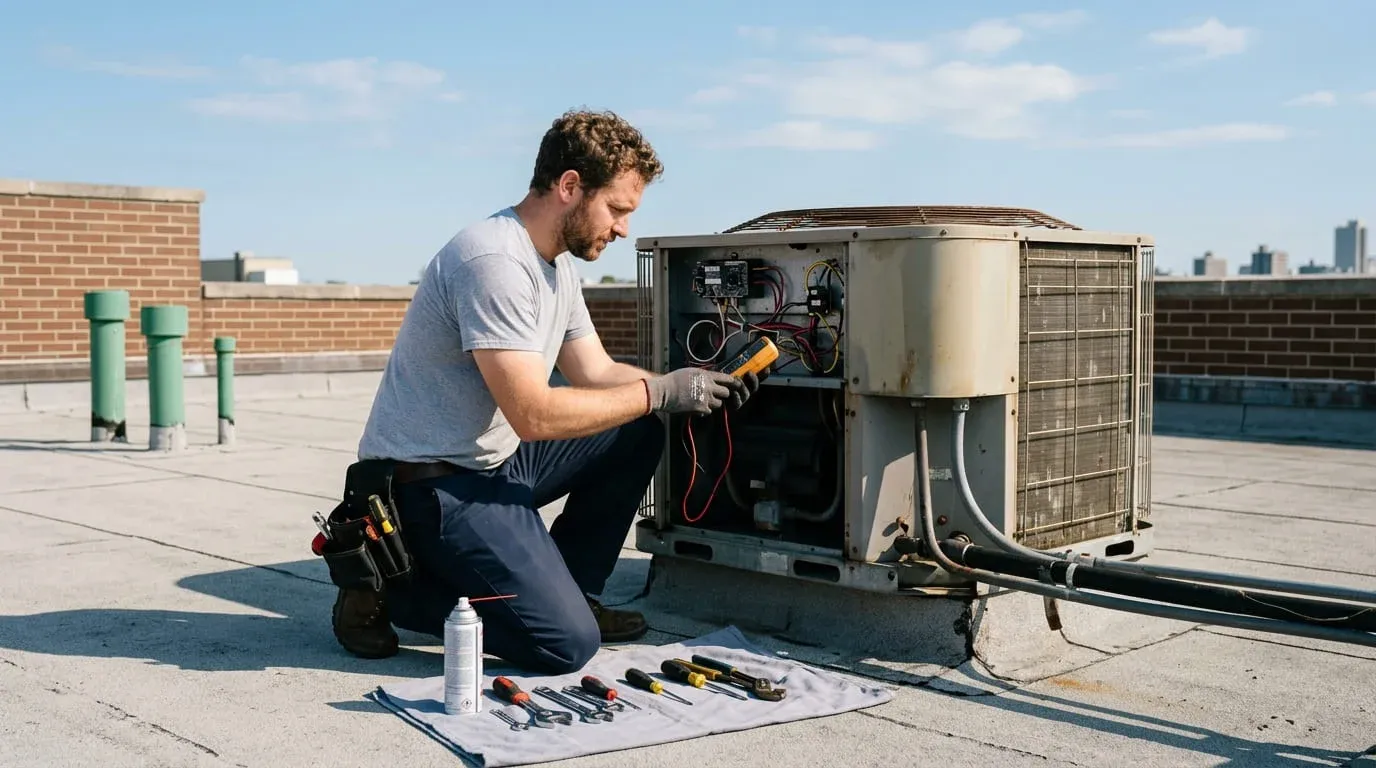
Texas AC systems work harder than anywhere else in the country — and fail accordingly.
A central air conditioner in the Gulf Coast corridor of Texas doesn't get the seasonal breaks that systems in most of the country do. In Houston-area suburbs and DFW communities, the AC runs from April through October — sometimes into November. The cumulative runtime over a 12–15 year system lifespan is significantly higher than the same system would accumulate in a moderate climate, and the failure modes reflect that: compressor wear, refrigerant loss from micro-leaks, capacitor failure from heat exposure inside the condenser cabinet, and blower motor fatigue from constant cycling.
When a system shows signs of strain — short cycling, inadequate cooling, unusually high utility bills, or a condenser that runs constantly without reaching setpoint — the problem is rarely just one component. A proper diagnostic assesses the full system: charge level, coil condition, capacitor health, airflow through the air handler, and thermostat calibration. Replacing a capacitor when the refrigerant charge is also low fixes one problem and leaves the other to fail a month later.
Lubbock TX Handyman handles the full range of HVAC repair work — from a single capacitor replacement to a full system diagnostic and replacement coordination. Full system replacements are coordinated with licensed HVAC partners to ensure proper permit, equipment warranty compliance, and correct refrigerant handling under EPA 608 certification requirements.
What's included
The most common HVAC failures in Texas homes
Capacitor failure is the single most common summer HVAC service call in Texas. Run capacitors provide the electrical boost that starts the compressor and condenser fan motor; when they degrade from heat exposure, the system either fails to start or runs inefficiently. Capacitor replacement is a quick repair — typically same-day — and significantly cheaper than compressor replacement.
Refrigerant loss from small leaks is the second most common issue. R-410A systems lose charge slowly over years through micro-leaks at fittings and coil joints. The system continues to cool — just progressively less effectively — until the charge drops below a threshold where the compressor can no longer operate safely. A proper repair identifies and fixes the leak before adding refrigerant, so the charge doesn't need to be replaced again in another year.
When ductwork is the real problem
A system that delivers poor comfort in one part of the house while the rest is fine is often a ductwork issue rather than an equipment failure. Ducts in Texas attics deteriorate faster than in conditioned spaces — UV exposure causes duct liner to delaminate, rodents create gaps, and connections at registers and boots come loose over years. A duct that's only 60% intact delivers a fraction of its intended airflow. Duct leakage into a hot attic also means the system is cooling attic air instead of return air, which dramatically increases operating cost.
A duct inspection during any HVAC service call catches these issues early — before they drive up utility bills or cause comfort complaints that get misattributed to the equipment.
From first call to a system that actually keeps up.
Call & describe
Tell us what's happening — no cool air, system short-cycling, high utility bills, or a unit that won't start. Photos or model numbers help but aren't required.
Diagnostic & estimate
A thorough system inspection with a written diagnosis and clear quote for repair or replacement — no pressure to approve anything on the spot.
The repair
Parts are sourced, the repair is done correctly, and the system gets tested under load before the job is called complete.
Final check
Supply and return air temps are verified, refrigerant charge is confirmed, and the system runs a full cycle before we leave.
Frequently Asked Questions
How long should an AC system last in Texas?
A well-maintained central AC system in Texas typically lasts 12–17 years. In the Gulf Coast corridor — where the system runs 8–10 months per year and operates under high humidity load — the lower end of that range is realistic. Coastal-area systems that run longer and harder accumulate wear faster than equivalent systems in drier Texas climates.
Why does my AC keep freezing up?
A frozen evaporator coil has two main causes: restricted airflow (usually a dirty filter or blocked return vent) or low refrigerant charge. Airflow restriction prevents the coil from absorbing enough heat, so it drops below freezing and ices over. Low refrigerant causes the same effect by lowering the pressure in the evaporator. A frozen coil should be thawed before running the system again — running it frozen damages the compressor.
When should I repair vs. replace my HVAC system?
The standard rule is: if the repair cost exceeds 50% of the replacement cost and the unit is more than 8–10 years old, replacement usually wins on a 5-year cost basis. A $600 capacitor replacement on a 5-year-old system is a clear repair. A $2,500 compressor replacement on a 14-year-old system in the Gulf Coast corridor — where it'll run hard for another decade — deserves a replacement conversation. We'll walk through the math honestly during the estimate.
What SEER rating should I look for in a Texas replacement system?
The federal minimum for new systems installed in Texas is now 15 SEER2 (equivalent to roughly 16 SEER under the old rating scale). In the Gulf Coast corridor and other high-cooling-load areas, 16–18 SEER2 typically pays back the premium cost within 4–6 years in electricity savings. Above 18 SEER2, the payback period extends — the efficiency gains diminish in proportion to the additional cost.
Does Gulf Coast humidity make AC problems worse than in other Texas cities?
Yes. High ambient humidity means the AC system has to work harder to remove moisture from the air in addition to lowering temperature — the latent heat load increases. This causes systems to run longer cycles, accumulate more wear on the compressor, and chill the evaporator coil closer to its freezing point on high-humidity days. Systems in Katy, Humble, Pearland, and similar Gulf Coast corridor cities consistently show more wear at a given age than equivalent systems in San Antonio or West Texas.
What causes a capacitor to fail, and can I replace it myself?
Capacitors fail primarily from heat — the oil inside breaks down after years of exposure to high temperatures inside the condenser cabinet. A failed run capacitor causes the compressor or fan motor to either not start or run inefficiently. Replacement is technically straightforward, but capacitors store a lethal electrical charge even when the power is off. Unless you have specific electrical training, this is a repair worth leaving to a technician.
HVAC Repair in your city.
Every town puts a different kind of wear on a home. These pages cover what the job actually involves in each city — the local soil, climate, and housing stock included.
HVAC Repair in Humble
Harris County
HVAC Repair in Katy
Waller / Harris County
HVAC Repair in Richmond
Fort Bend County
HVAC Repair in Willis
Montgomery County
Don't see your town? See all service areas or ask about your address.
Don't wait out a Texas summer with a struggling AC system.
Free written estimates and a diagnostic that tells you exactly what's wrong before any parts are ordered.